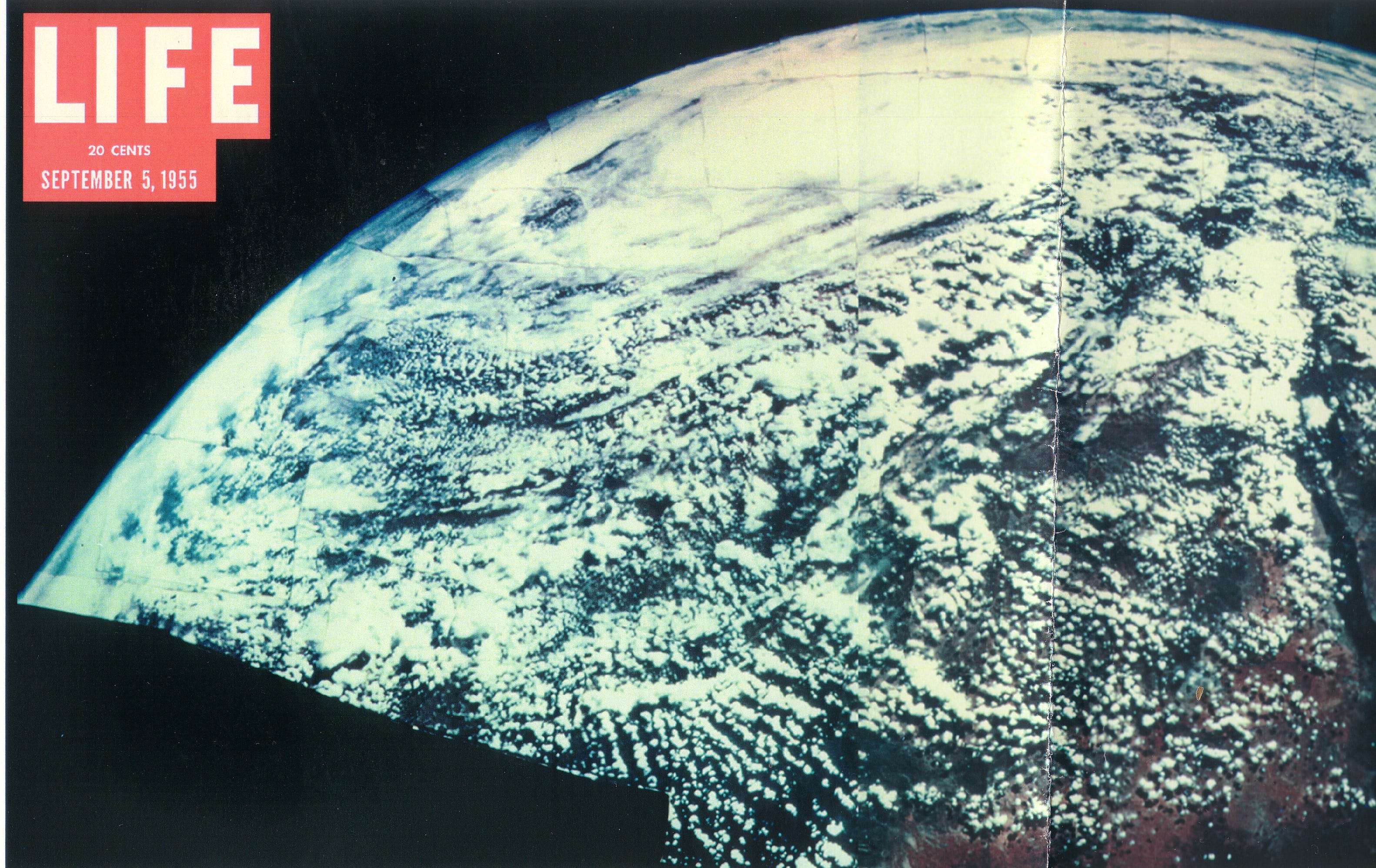
The September 5, 1955, issue of Life Magazine featured the first-ever color photograph of Earth taken from space. Otto Berg, the man who made it happen, was early in his career as an astrophysicist in the Rocket Sonde Branch of the Naval Research Laboratory (NRL) and engaged in the study of radiation at high altitudes. In the later 1940s and early 1950s, he participated in numerous rocket launches at the White Sands Proving Grounds in New Mexico, standing so close that he felt the earth around him shake.
I had the good fortune to be introduced to Otto by a mutual friend, and Otto and I worked together for three years on a memoir of his rocket and space adventures. Otto was one of the most intelligent, accomplished, humble, and amusing individuals I have ever met, and he was an engaging storyteller.
The story that follows, from Otto’s to-be-published memoir Adventures of a Rocket Scientist, is his account of how the photograph of Earth came to be. It was voted one of the ten best technical photos from the decade of the 1950s, and it is currently on display in the Smithsonian Air and Space Museum. In 1977, Otto received the NASA Medal for Exceptional Scientific Achievements in recognition of his accomplishments.
In Otto’s words…
After the V-2 and later versions of rockets proved to be a reliable way to carry experiments and instruments into the upper atmosphere, scientists began to consider and prioritize the types of experiments to be conducted. Space in the nose cone was limited because the electronics and batteries used by the experiments hadn’t been miniaturized in the 1940s and 1950s as they are today. They were large, fragile, and took up much room. Photography of the Earth was not even on the list of prioritized experiments, because it was not considered of interest or importance towards solving the mysteries of space. However, a member of our Rocket Sonde Branch, Leo Winkler, persuaded one of the payload managers to include a K35 camera as part of the instrumental experiments in a V-2, and he succeeded in obtaining a few black and white exposures of the Earth’s horizon. No geographic details were detectable, but the photos were assembled to demonstrate for the first time a limited segment of the Earth’s curvature. Newspapers across the country carried photos that refuted the argument that the earth was flat.
Johns Hopkins University later tried to photograph Earth in color but failed. They concluded that it would be impossible to do because of the haze layer that surrounds Earth. They said that the layer serves as a mirror reflecting the sunlight and thus masks the planet’s surface from view.
As a stubborn Norwegian, the word “impossible” caused my metabolism to soar; I felt I could prove John Hopkins University wrong. In addition to the experiments I worked on, I had been assigned responsibility for the Rocket Aspect System, which involved a 16mm gun camera equipped with a wide-angle lens and loaded with infrared film that was mounted on our rockets. This system came about to meet the scientists’ requirement of knowing not only the altitude of the rocket but also its exact attitude (vertical position) and spin positions so the experimenter could constantly relate the data to the altitude and viewing relative to the Earth’s axis and the Sun. The film repeatedly recorded the relative angle of the Earth’s horizon and the position of the Sun, a combination that precisely nailed down the required information.
I proposed a photographic experiment to provide a 16 mm color movie film of the Earth as part of the Rocket Aspect System. The proposal was accepted. My experiment would use a Wratten optical filter that I had been using in other experiments, and I knew it would filter out the reflections from the haze layer. The black and white film used in the Rocket Aspect System was much faster (more sensitive) than the color movie film I proposed to use. I needed to modify the camera to produce a higher shutter speed so that the photos of the Earth’s surface would show significantly greater detail. I dabbled with a design that used a rotating disc shutter that produced an acceptable shutter speed of 1/1200 second. (Unfortunately, I did not apply for a patent of my design.)
The Aerobee rocket used for this project was scheduled for an early morning launch. As I lay in bed the night before, I realized that I had not refocused the camera for the vacuum conditions of the upper atmosphere. (The focal length must be changed as a lens goes from atmospheric pressures to vacuum pressures due to a term called the index of refraction.) I knew the project manager would not delay the launch to allow me to correct my oversight. I lay awake scheming and dreaming up explanations for the 50 feet of fuzzy color film that would be recovered from the rocket. As I went out to the launch site early in the morning, I was told that the rocket had developed a fuel leak during the night and all instruments would have to be removed. An answered prayer. All that sleep I missed and the ingenious excuses I had thought of were for naught.
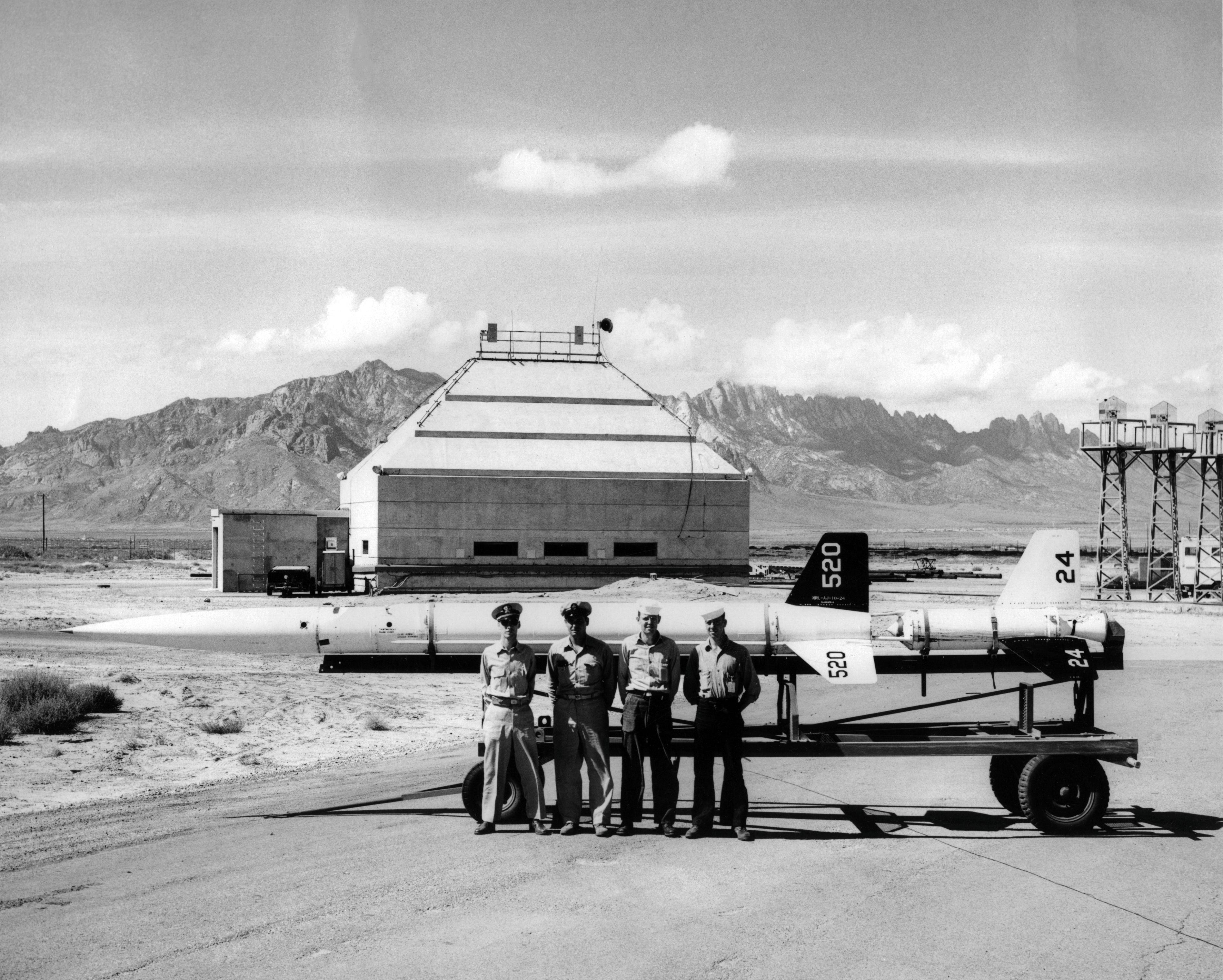
The Aerobee rocket shown contained Otto’s camera in its nose cone.
The rocket launch went smoothly, and at its peak altitude of 100 miles, it behaved differently than normal, as though it had been programmed to favor a photograph of the Earth’s features. Usually, at its peak, the rocket would violently reverse its vertical orientation (relative to the Earth’s surface) and then break into two sections (upper nose cone and lower fuel and rocket motor section) that would come tumbling through the atmosphere and crash into the New Mexico desert. Instead, the rocket tipped and rotated (spun) slowly from vertical, which allowed the camera mounted on its side to alternately photograph a strip of terrain, starting at the horizon, and then a section of open space, and then a lower strip of terrain until about one-half of the Earth visible from a distance of 100 miles had been recorded on color film. Was the trajectory Divinely controlled to provide this first-ever photo coverage? I think so.
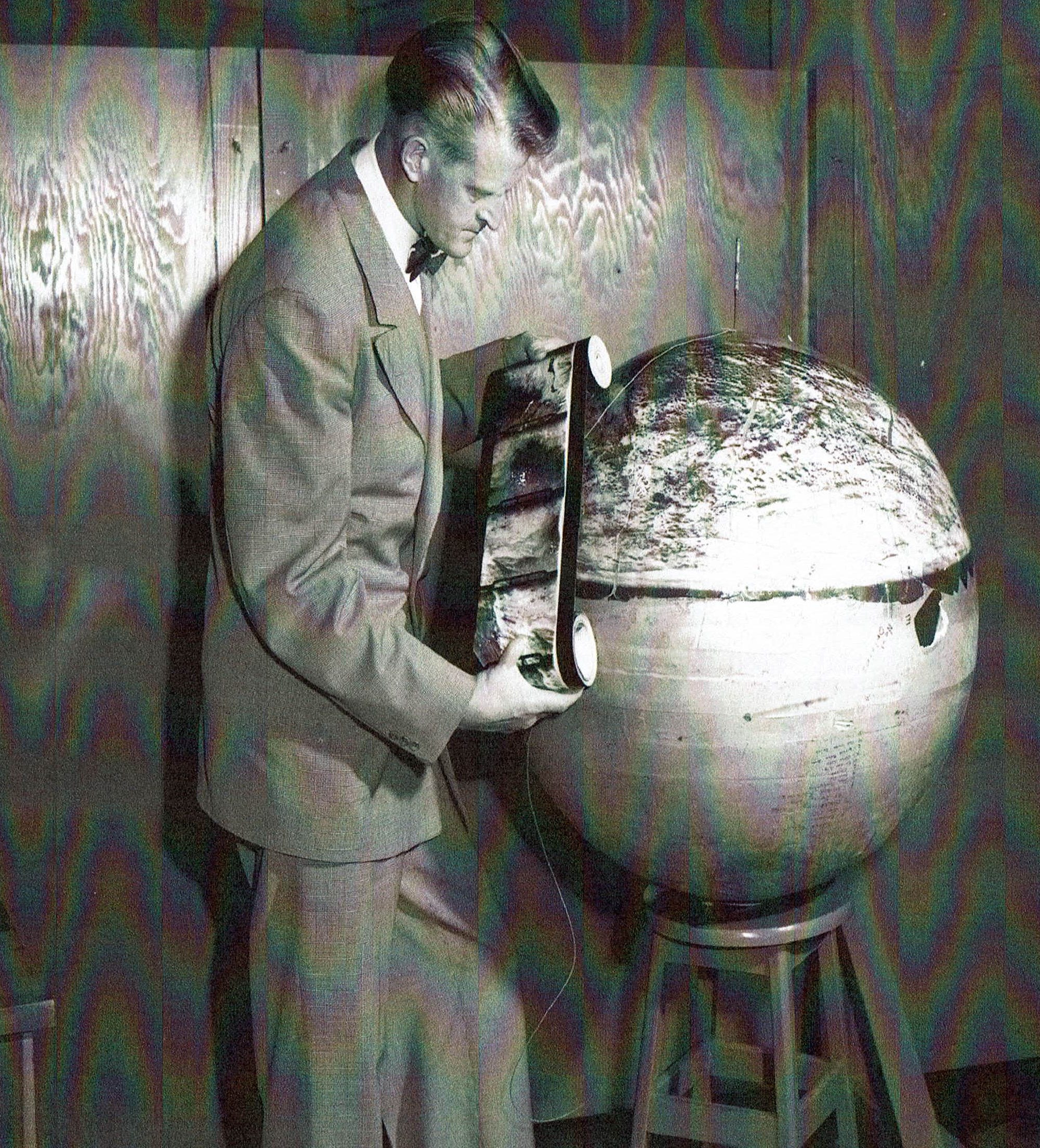
I anxiously awaited post-flight recovery of the camera and film. When it came back from processing, I was pleased to see that the exposure was essentially perfect. I was pleased, also, that the gradual photographic recording of the horizon in color stood out in sharp contrast to the blackness of space as the Earth’s atmosphere ended. I enlarged several 16 mm frames of horizon shots to see if the Earth’s curvature would be significant. Indeed, it was, so I enlarged and printed every third 16 mm frame over a longer period of the flight, and that also worked out well. Then, I enlarged and printed 3 x 5-inch prints of every third movie frame for the entire 50 feet of Kodachrome 16 mm film. I spread out 400 color prints on our dining room table at home and assembled about 140 of them into a photo of Earth.
There, on our dining room table, lay this three-feet high by four-feet wide montage. I cannot say that I was extremely excited about it, but I considered it a photographic feat. My wife was even less impressed, but, with three small children to feed, she was happy to regain the use of her dining room table “for more useful purposes.” I took the montage to work the next day. My colleagues were impressed by it, but they did not consider it anything extraordinary. As I mentioned earlier, photography wasn’t on the list of priorities for things to do with our rockets.
Otto assembled about 140 color prints into a photo of the Earth.
One thing I noticed of significance in the photo is that it showed the formation of a hurricane over Texas. I telephoned Dr. Harry Wexler, the head of the U. S. Weather bureau, described the photo to him, and noted that it showed a hurricane. When he came to view the photo, he was totally dumbfounded. He had studied the weather synoptics for that day and had seen no evidence of a high-energy storm. Their weather data, obtained by photography from ground levels, merely showed a low energy cloud system over Texas, but it had mysteriously dumped four inches of rain on Brownsville, Texas. The montage, assembled from photographs taken from above the cloud systems, revealed for the first time that a high-energy cloud system (hurricane) could be totally shrouded from ground detection and observations by a low energy cloud system. Dr. Wexler’s enthusiasm and excitement upon seeing the montage led to the Weather Bureau realizing for the first time that accurate weather forecasting necessitated weather observations from the ground and from space. The photo initiated the Rocket-borne Meteorological reconnaissance and study of Earth’s storms and the present-day satellite reconnaissance programs.
Given this renewed enthusiasm for the montage, my boss, Dr. Les Meredith, and I decided to take the photo to the National Geographic Society in the hopes that they would be sufficiently interested to reproduce it in professional color. They sadly declined based on the high cost involved. On the return to the Naval Research Library, we passed by the Life magazine offices and decided to see if they would print it in true color. As word of the photo spread, we were surrounded by every member of their organization—I believe even the janitors. They tried their darndest to talk us into leaving the photo with them overnight, but we declined. We did, however, allow them to photograph it.
That double-page spread in Life magazine triggered a lot of activity in my professional life for several weeks. I received an urgent, official letter from an admiral’s office in the Navy Department in Washington, D.C. It demanded my presence in a meeting with high Navy brass to answer their charge that I had shown a Navy photograph to the news media (Life) without official permission. I was accompanied to the meeting by Dr. Meredith and Dr. Homer Newell, head of Rocket Sonde. The Navy brass argued that the photo was official Navy data and under Naval command. Dr. Newell countered with the statement that the photo was a scientific issue and, as such, was under his direction. Whew. A lot of smoke, but no fire.
Otto Berg
The montage appeared in newspapers all around the world. Life magazine and the Associated Press were continually inundated with telephone calls asking about the picture. I received a letter from the office of moviemaker Mike Todd. They asked to borrow the 16 mm movie film so they could use it in one of his productions. We went through proper Navy Department channels to get permission to send to him a copy that was identical to the original. Mike Todd wrote back to me saying they needed the original film. I answered that the original film would not be available and assured him that the copy was identical. A week or so later we got an official letter from the Navy Department with the order, “You WILL send the original film to Mike Todd.” We complied. As far as I know, the Navy Department never returned the original film. The pictures from it were used in the opening introduction to Todd’s movie Around the World in 80 Days. Did we get free tickets or passes? No, but neither were we investigated by the Navy Department Ethics Committee.


A great story here Mike! Thanks for sharing!
What a great project! I think I remember that Life Magazine picture. I’m thinking of so many people who would enjoy this science history.
👏👏👏👏👏