

Down the Road
Challenged yet cheerful

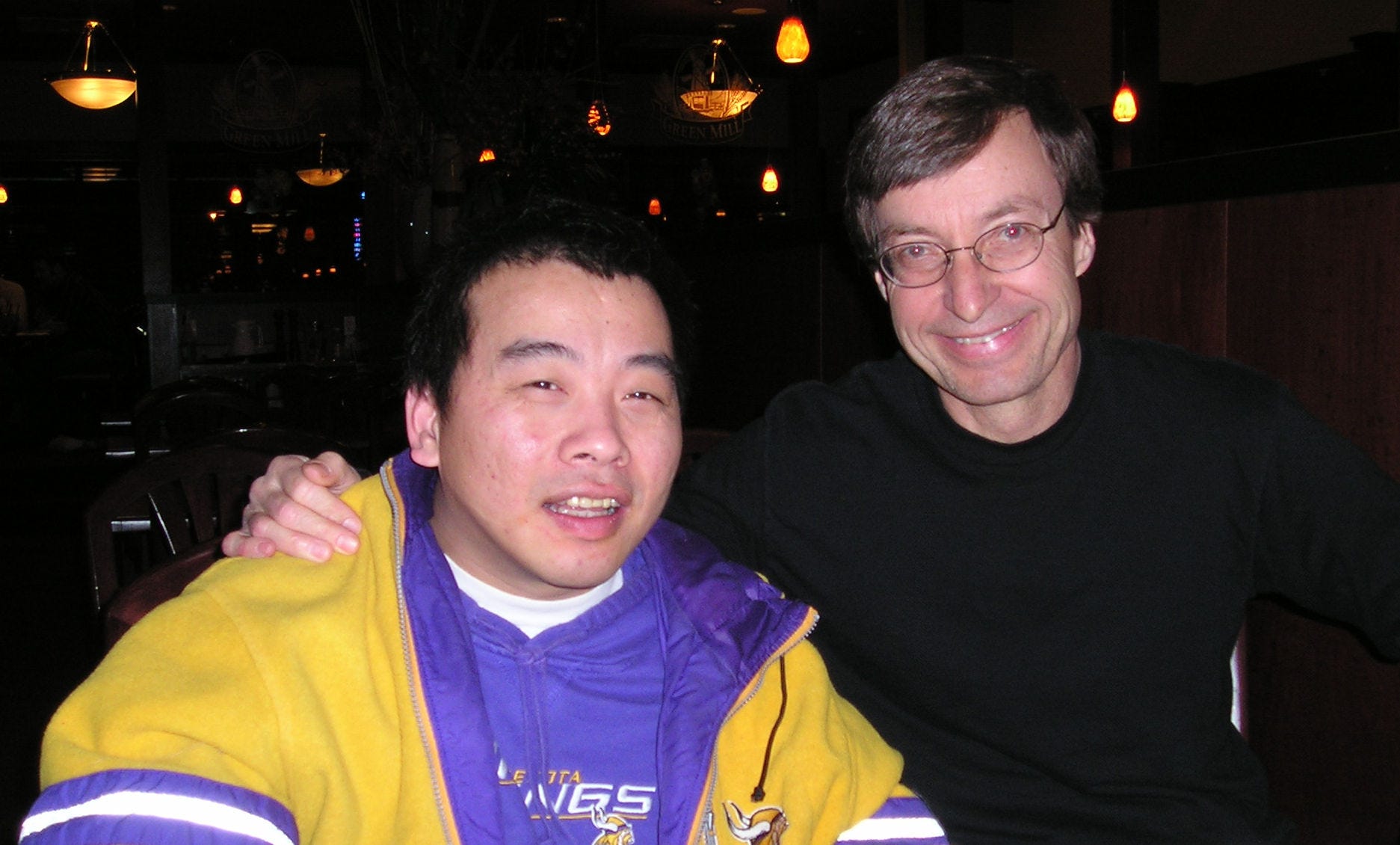
Every person we meet—a man named Chau, for example—has something to teach us. My wife, Jeanine, and I came to know Chau through long-time friends Gene and Jan Jones. They were moving from Rochester, Minnesota, and asked if we might befriend him. “He’s quite a guy,” they said. “You’ll love him.” Jan was a registered physical therapist and had begun working with Chau in 1983, when his physiatrist (doctor of physical therapy) became concerned that his home situation might be unsafe.
Chau (Mike) Huynh (pronounced win) was born in Saigon, Vietnam, in 1970, the third of seven children in a relatively well-to-do, entrepreneurial family. The Vietnam War was in full swing. When he was six months old, Chau received immunization shots for the normal childhood diseases. He reacted to one shot with an extremely high fever; the result, tragically, was paralysis and spasticity in both of his legs and one arm. The medical term for his condition is tetraplegia. When this happened, his parents hired a young girl, twelve-year-old Xiem, to live with them and care for their baby boy. (She and Chau live today in their Rochester Habitat for Humanity home.)

North Vietnam won the war in 1975, and as the years went along, Chau’s parents feared that the communists might take Chau from them and possibly kill him. They felt, too, that he could receive better physical therapy in America, so on New Year’s Eve, 1981, they put Xiem, Chau, and his brother Trung (Andy) on a refugee boat with the goal of their making it to the United States. (Though Trung was not disabled, his parents felt he had a greater chance for success in the United States than in their home country under communist rule. He would go on to graduate from the U of M, now lives in Minneapolis, and owns a successful software business.)
The three children were on an overcrowded boat with 137 other refugees. They had little food and water and no specific destination. After four days and three nights at sea, they were spotted by a Thai fishing boat; the fisherman towed the refugees near land and gave them much-needed nourishment. The children were placed first in a small refugee camp in Thailand and then moved after a month to a larger camp. Chau says his experiences there were “so, so”—some good, some bad. The three applied to come to the United States and Rochester resident Bob Jones agreed to sponsor them. On September 2, 1982, they arrived in Rochester.
Xiem, Chau, and Trung moved into a mobile home in the Silver Lake Travel Trailer Park. Xiem began working for Rochester Meats, where she still works today. A year after coming to Rochester, Chau started grade school at Harriet Bishop Elementary School. Because Chau had had minimal schooling in Vietnam and spoke little English, Xiem reported his age as three years younger than his actual age. Xiem met a man with whom she, Chau, and Trung lived for a while, but when he became involved in some unpleasant activities, he left home.
That’s when Jan Jones entered the picture. Her first impression of Chau was that of a shy little boy who needed a mom. He was conscious of his poor English and his disabilities. She became not only his therapist but also his surrogate mother. She visited him multiple times a week to perform therapy and talk with him to help improve his English. She recalls, “He was an extremely hard worker. You gave him something to do, and he’d do it. He was never a difficult person in any way. He would never get angry or tell you to go away. And he always was more than willing to do whatever was asked of him.”
Chau attended John Marshall High School, and during those years he experienced some problems with depression. The term used to describe his condition was “thinking, thinking.” Chau overthought everything; he’d dwell on the negative and how little he could do and how difficult life was for him. He began to see a psychologist, who helped him a great deal; she became another critical cog in his support system. Chau is a fighter for what he believes in.
During one of his “thinkings” he wondered why his high school didn’t have doors that he could open by himself. He worked with the Rochester City Council and the local media to bring attention to the problem, and eventually door openers were installed. He worked with Mayor Chuck Hazama, too, to see that cutaway curbs were installed around town so those in wheelchairs could more easily cross streets. He worked with the owner of the city bus company to change its policy of offering bus service to handicapped persons only at certain times to one of making all buses and routes available to them.
Gene and Jan Jones said, “Chau has made us so aware of how difficult life is—for refugees, for handicapped individuals, and for anyone that doesn’t have English as their first language. Most important, he has shown us that you can have joy in life despite all of those challenges.”
Jeanine and I hit it off immediately with Chau. He loves sports and has an amazing knowledge and recall of all sporting-related events. He is up to speed on the latest information technologies—computers, printers, cell phones, and wireless systems. (He can’t believe I don’t know our internet provider’s data transmission rate or my laptop’s processor speed.) He knows much about world and local events. He loves most to laugh and tease. He often calls me “Mikey.” When Jan was working with him regularly, he would kid her by saying, “You’re looking really old these days,” just to get her goat.
My inclination is to be quick to lend a hand to anyone who needs it, but I realize how important it is for Chau to do all he can by himself. Take the simple task of getting into a car. With Chau, I open our passenger door, pull his wheelchair up near the seat, and lock its brake. Chau reaches for the open door with his good arm, pulls himself up, and twists his immobile body to turn his back to the seat, and I then help ease his rigid frame backward into the car. All the while, he’s saying, “I got it. I got it.” He’s often out of breath from the effort he’s expended. “How’re you doing, Chau?” I’ll ask after he’s in the car, and he’ll look up at me with that grin of his and say, “No pain, no gain.”
Despite his challenges, Chau never complains. He will celebrate his 56th birthday tomorrow (March 20), and he laughs when I remind him that he is “still a kid.” Chau and I usually end our phone conversations with, “See you down the road,” which is our way of saying, “Thanks for being such a good friend.”

Thinking of Chau’s life reminds Jeanine and me that there are many caring people in the world — Bob Jones, Gene and Jan Jones, Xiem—who help others through tough times. Like them, may we all touch a heart, sometime, somewhere.
This is a beautiful story Mike. Happy Belated Birthday to your friend. Shows how a little bit of kindness goes along way. :-)
This is a beautiful story, Michael! As a refugee myself, I can relate to how difficult it is to learn a new language and to assimilate in a new country. I could just imagine how hard it must have been for Chau. What an amazing strength and perseverance! Happy belated birthday to your friend.